
Why more boost doesn't make more power on a diesel
On a turbocharged petrol engine, boost is close to a power dial. Raise it, add the fuel to match, keep knock and temperatures in check, and the dyno usually rewards you. So it is natural to expect the same from a turbo diesel. Turn the boost up, and the power should follow.
It doesn't. On a diesel, raising boost on its own barely moves the power figure. It still changes plenty under the bonnet, some of it useful and some of it not. HP Academy put this to the test on a real truck, and the results are a clean lesson in how a diesel actually makes torque.
The test: three boost targets, same fuel
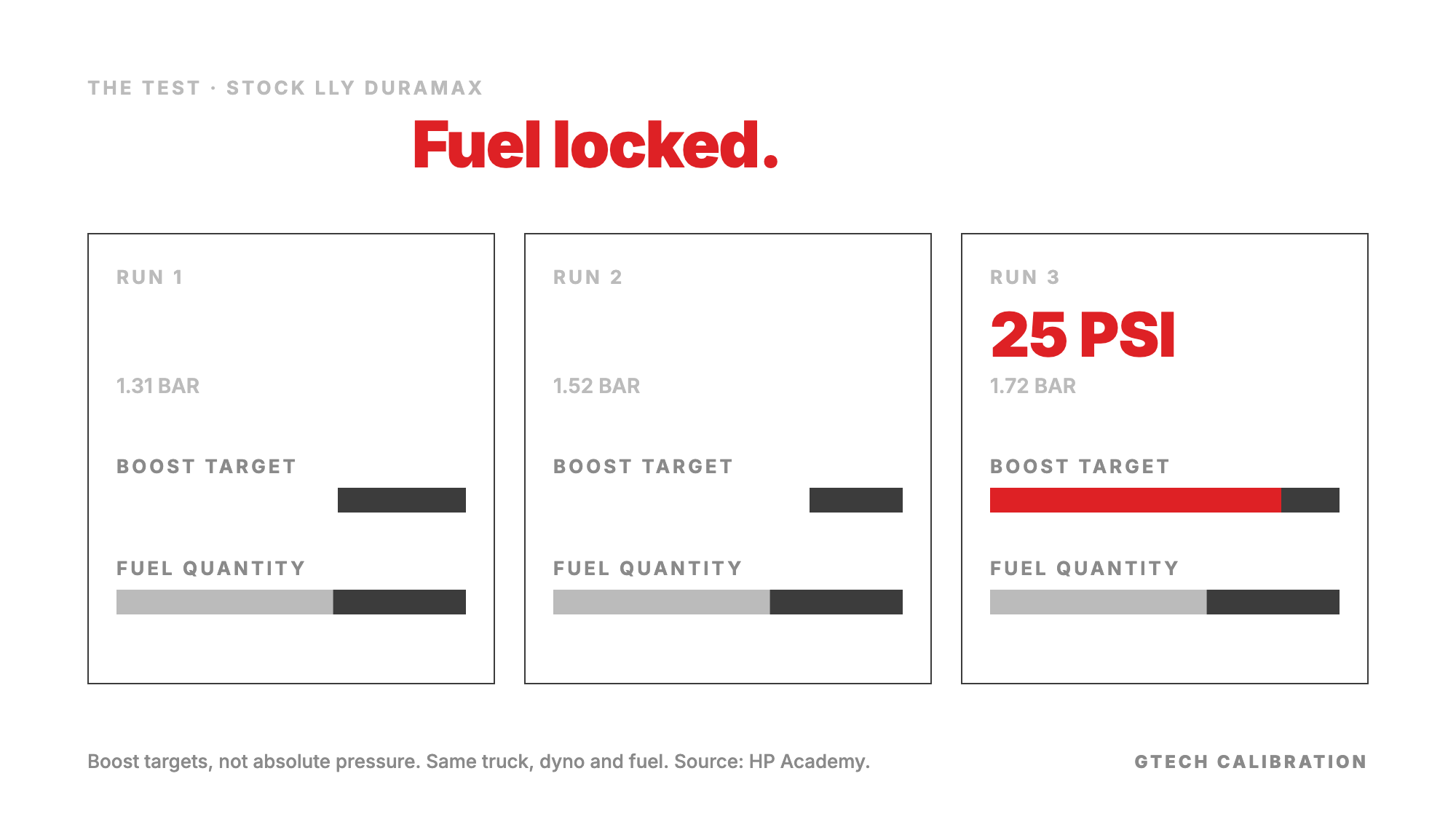
HP Academy tutor Nick Priegnitz took a stock 2005 LLY Duramax and ran three calibrations on the same dyno. The only change between them was the commanded boost pressure:
19 psi (1.31 bar)
22 psi (1.52 bar)
25 psi (1.72 bar)
Fuel quantity stayed exactly the same on all three. These are boost targets rather than absolute manifold pressure readings, but the truck, the dyno and the fuel did not change.
The turbocharger did its job. The variable geometry vanes moved, actual manifold pressure followed each target, and the engine got more air with every step.
The mix went lean
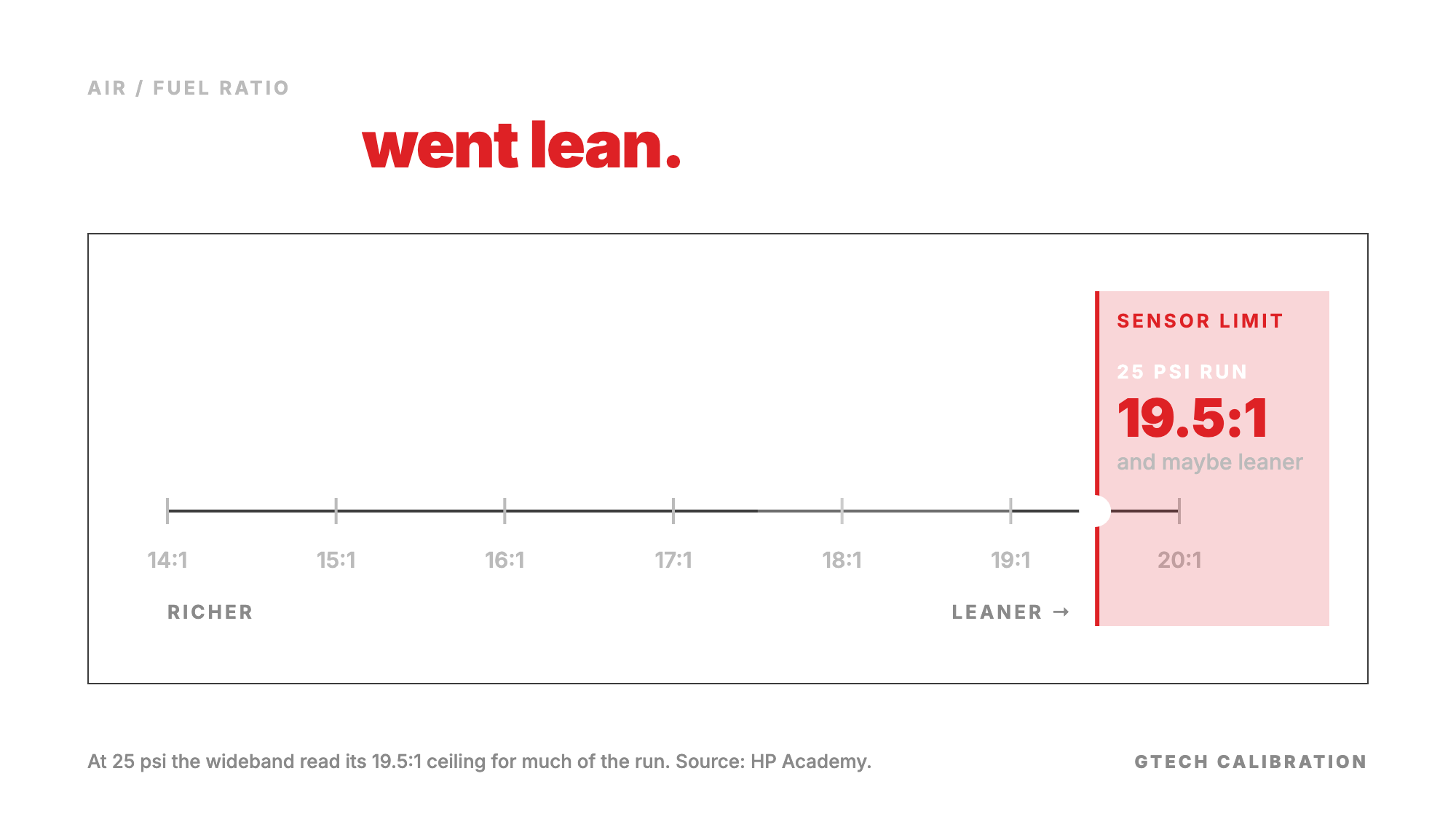
More air with the same fuel means a leaner mixture, and the logs showed it clearly. On the 19 psi calibration, the air/fuel ratio sat at roughly 17.5:1 to 19:1. On the 25 psi calibration it climbed to the wideband sensor's upper limit of 19.5:1 and stayed pinned there for much of the run, so the real mixture may have been leaner still.
That is a big, measurable change in the combustion conditions.
And the power? Less than 10 hp
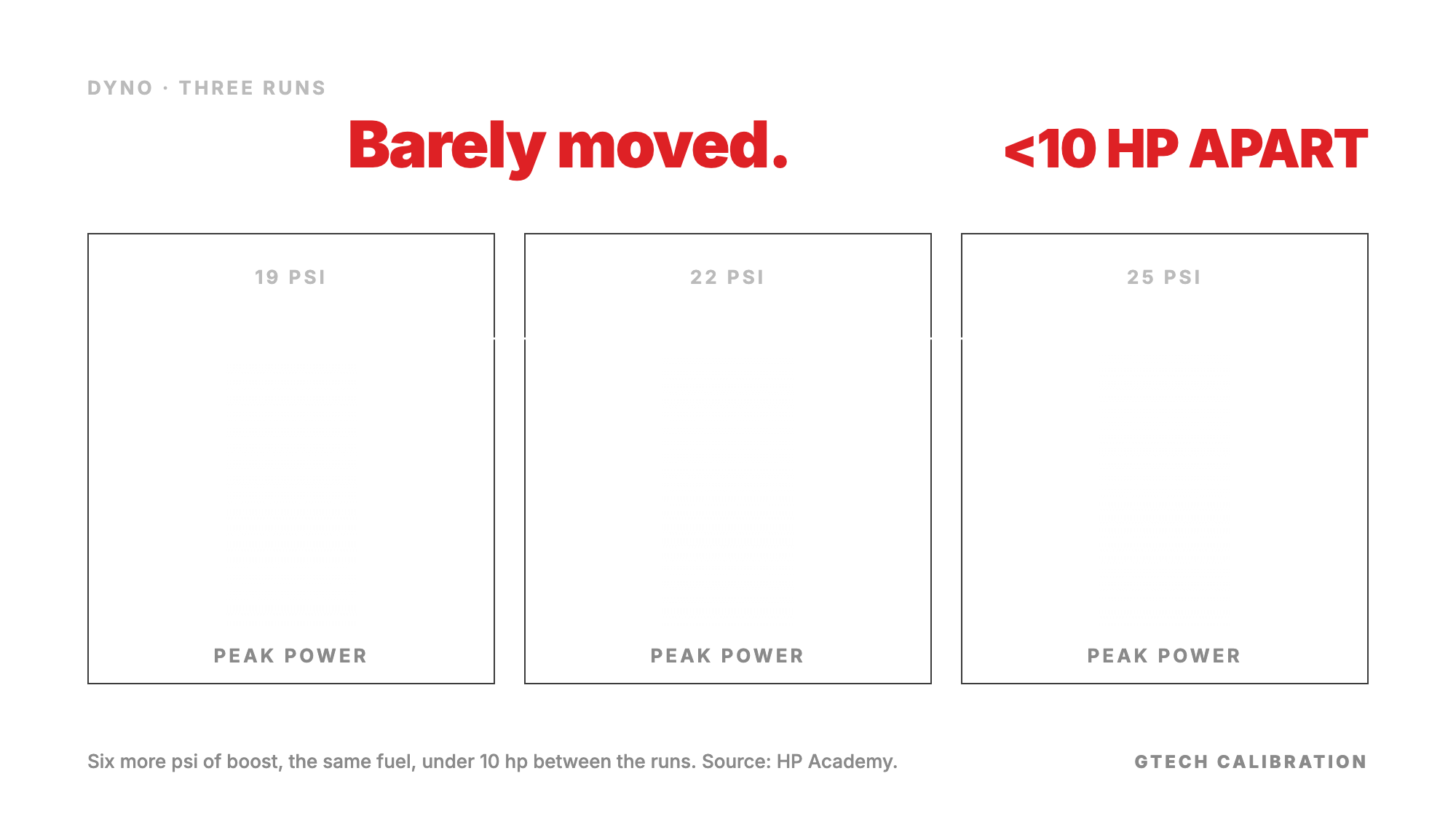
Across all three runs, less than 10 horsepower separated the results. Six more psi of boost, a much leaner mixture, and no practical change on the dyno, let alone in the seat of your pants.
Why: a diesel makes torque from fuel
A petrol engine runs close to a fixed air/fuel ratio. More air lets you add more fuel, so boost and power move together.
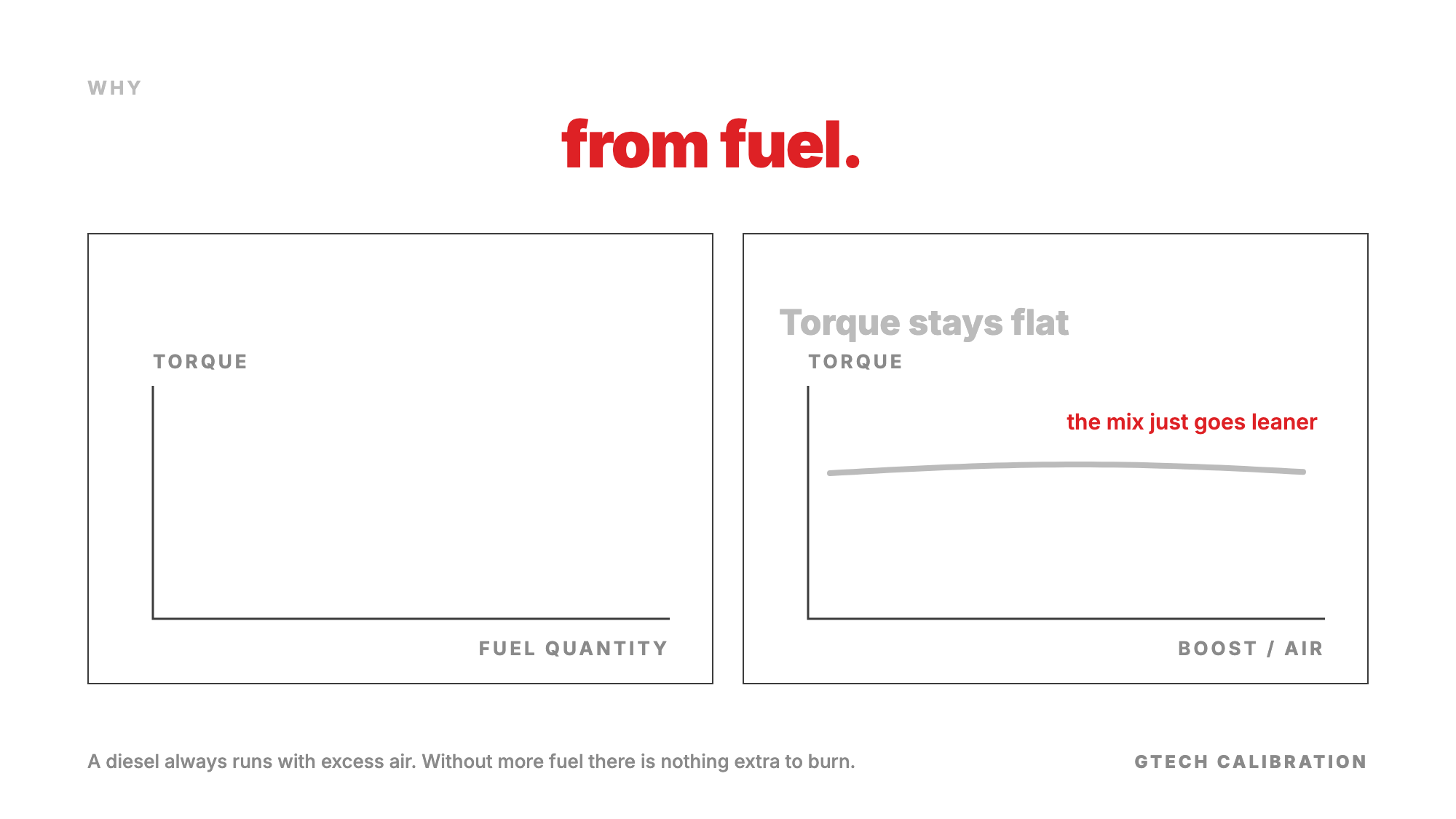
A diesel works the other way around. It always runs with more air than it needs to burn the fuel, and its torque is set mainly by how much fuel is injected. If the fuel quantity does not change, there is nothing extra to burn. The additional air simply dilutes the charge and leans the mixture out.
That is why boost cannot be treated as a stand-alone power adjustment on a diesel. On its own, it changes the air/fuel ratio, not the output.
Is more boost a waste of time?
Not necessarily. A leaner mixture means more oxygen available for the fuel that is injected, and that has real benefits:
Less soot. Better oxygen availability helps the fuel burn more completely, which means less smoke and less work for the diesel particulate filter.
Exhaust gas temperature control. Depending on the operating conditions, extra air can help keep EGT down, which matters for both engine and turbocharger reliability.
These benefits become most useful when you start adding fuel to make more torque. Boost is part of what lets a diesel use more fuel cleanly and safely.
The cost of boost you don't need
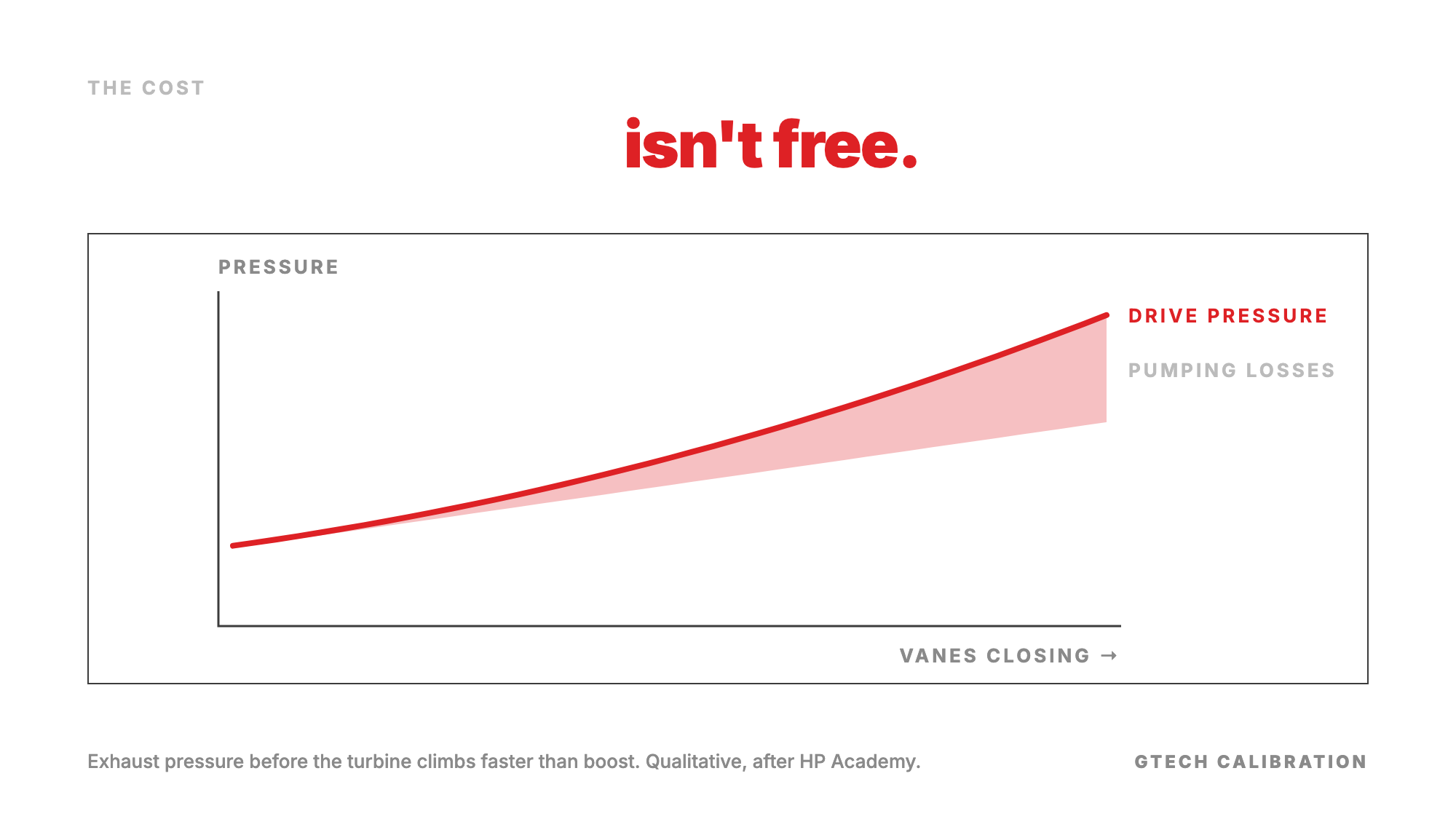
There is always a trade-off, and with boost the catch is that the turbocharger has to work harder to make it. On a variable geometry turbo, closing the vanes raises boost, but it also raises the exhaust pressure before the turbine, known as drive pressure.
Push that too far and it starts working against you:
Drive pressure climbs faster than boost pressure.
Pumping losses rise, because the engine has to push its exhaust out against that pressure, and overall efficiency falls.
The turbocharger can be pushed out of its efficient operating range, or towards its mechanical limits.
Nick sums up his own approach well: he doesn't want to run the turbocharger needlessly harder, or clamp the vanes or the wastegate down to reach a lambda of 1.4 (roughly 20:1) if the engine doesn't need it. If there is already enough air to burn the injected fuel efficiently, forcing more through the engine only costs you.
The takeaway: tune fuel, lambda and boost together
The practical lesson from the test is simple. Boost went up by about 6 psi, the mixture got noticeably leaner, and the power barely moved. So on a diesel:
Fuel quantity sets the torque.
Boost is there to supply the air that fuel needs, with enough margin to keep smoke and exhaust temperatures under control.
Lambda (or AFR) is how you check that the two are in balance.
If you raise boost purely to chase horsepower, make sure the engine also gets the fuel to use that air. And if you add fuel, make sure the boost is there to burn it cleanly, without asking the turbo for pressure the engine does not need.
Tuning a diesel?
At GTECH Calibration we build calibration files with fuel, boost and lambda working together, not one map at a time. If you are a tuner, register for the file service and send us your read.
Source: HP Academy, "Why More Boost Won't Make You More Power" by Taz Quinn-Walshe (hpacademy.com). The test data in this post comes from that article. Cover photo by Daniel Morton-Jones on Unsplash.