
Why running rich doesn't make an engine safer
Ask around any workshop and you will hear it: when in doubt, run it rich. Extra fuel is treated as insurance, a margin you can always fall back on if the engine feels hot or the timing feels brave.
There is some truth in it. But past a point, more fuel stops buying safety, and it can even hide the problem you were trying to avoid. HP Academy covers both sides in its Understanding AFR course and in tutor replies on its forum, and together they draw a clear line.
Where richer really helps
Fuel does more than burn. As you richen the mixture, the combustion temperature drops. In a heavily knock-limited engine, HP Academy explains, that can move the engine away from the knock threshold and let a little extra timing be added safely.
If the engine was knock limited before, that extra timing will often bring more power. The test is simple: aim 0.2–0.3 lambda richer, re-optimise the ignition timing and see whether the engine responds. If it does and the engine is still knock limited, it is worth trying an even richer target.
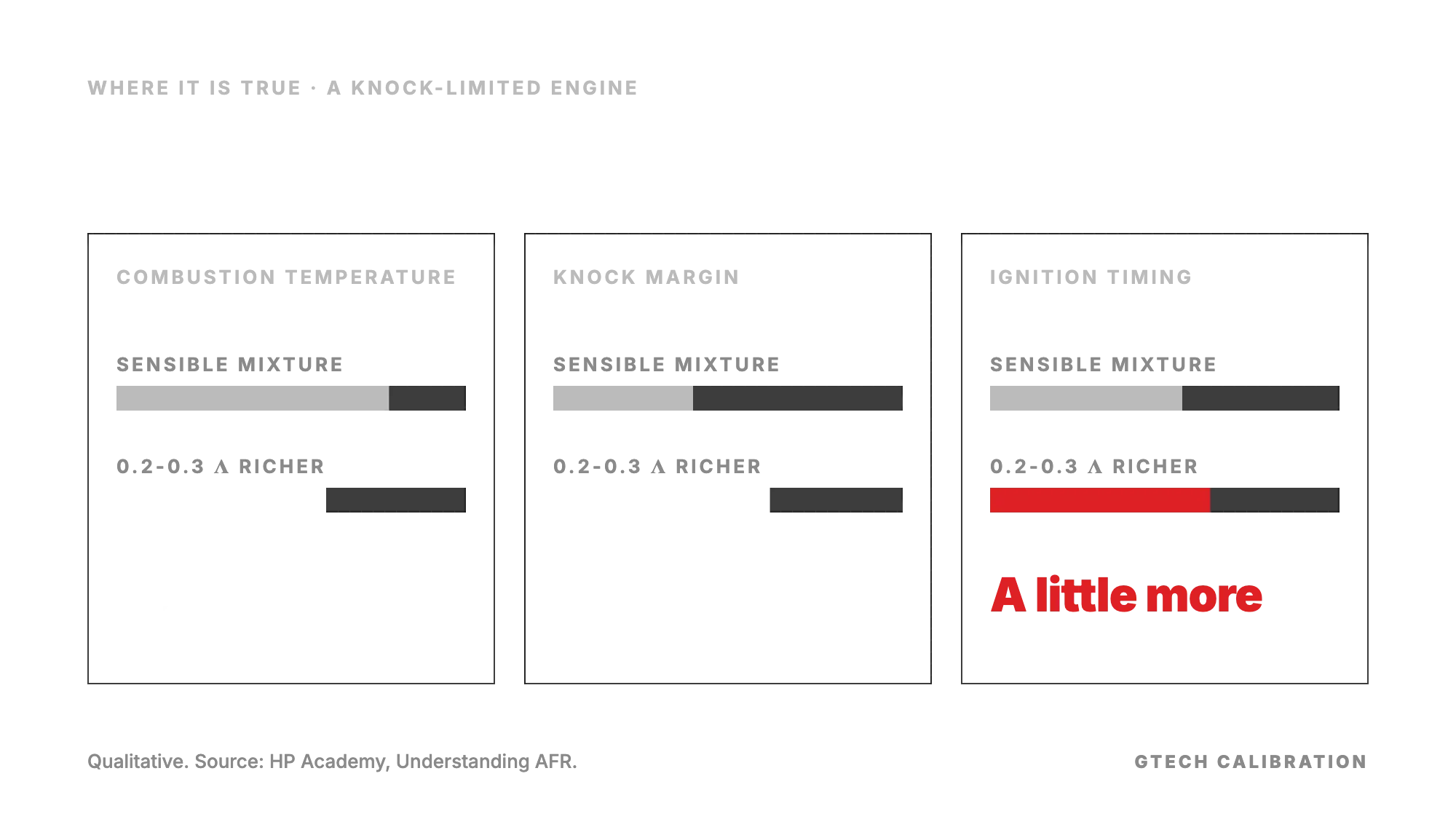
Note the conditions: a knock-limited engine, and timing that is re-optimised afterwards. The fuel on its own is not the gain. The gain is the timing it lets you add.
Power barely moves
Outside that case, the mixture is a much smaller lever than it looks. HP Academy suggests moving the mixture both richer and leaner by about 0.2–0.3 lambda to see what it does. Provided you tuned to a sensible AFR from the start, power should not move by more than 1–2%.
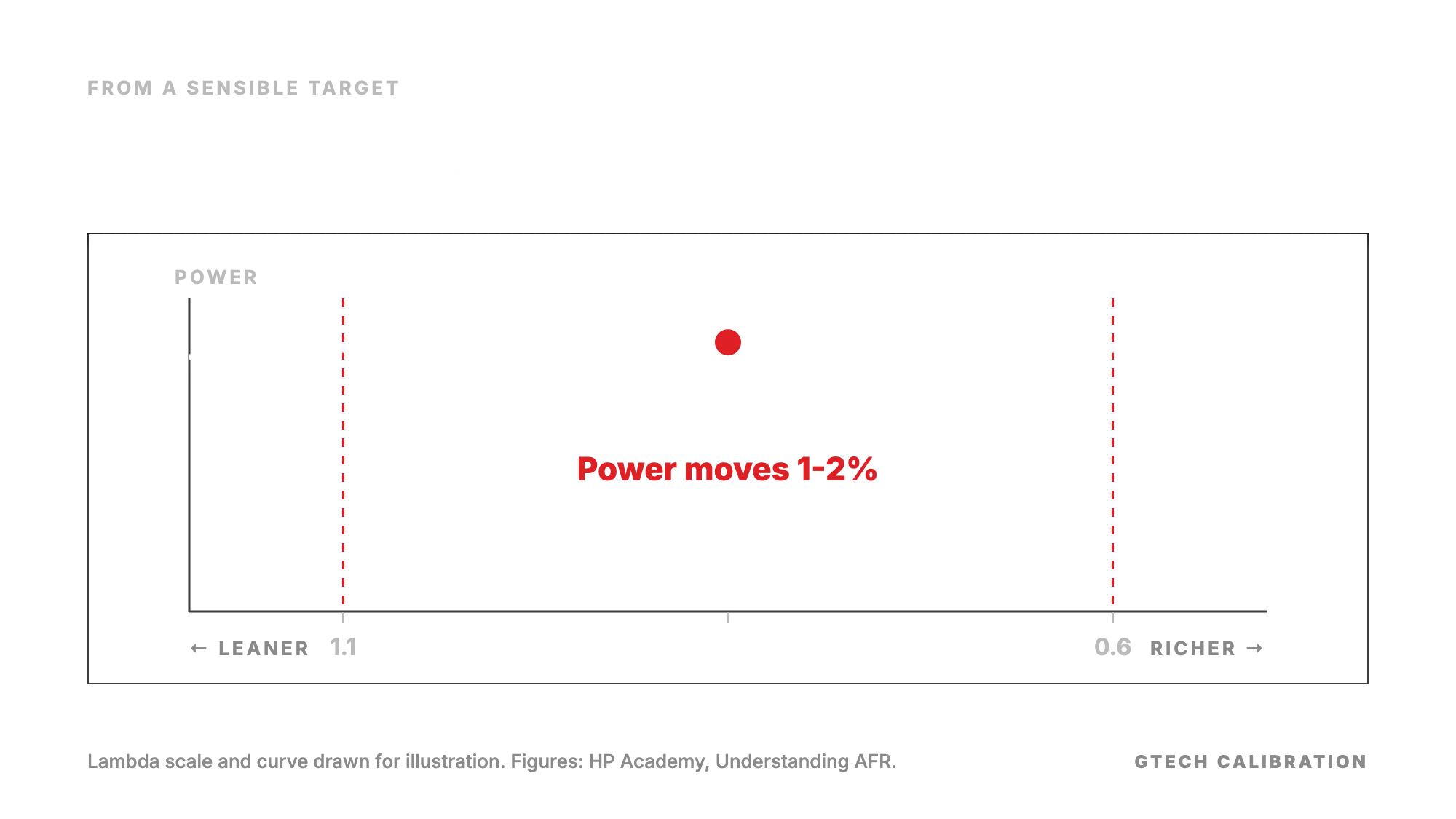
So piling on fuel does not buy power, and on an engine that is not knock limited it does not buy timing either. It only moves you along a flat stretch of the curve towards the rich end.
Past a point, the spark gives up
Keep adding fuel and the mixture eventually gets too rich to light reliably. Asked whether full-throttle fuelling could wash the bores, HP Academy tutor Chris Wall replied that the amount of fuel needed to bore wash would cause quite an aggressive misfire, and the engine would struggle to accelerate.
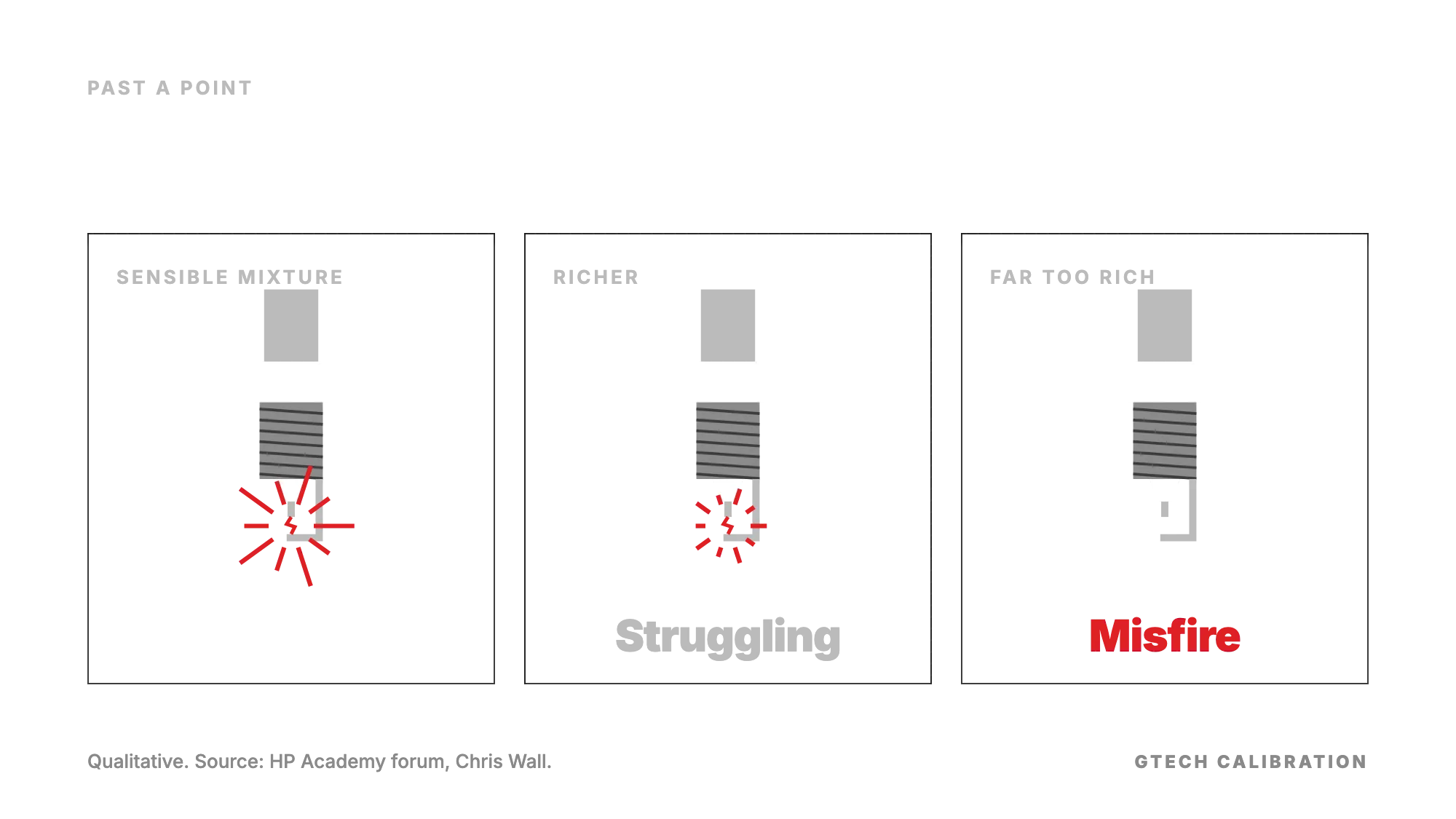
In other words, the rich end of the scale does not end in a safer engine. It ends in a misfire.
The trap: a rich misfire reads lean
This is where running rich turns from wasteful into misleading. A wideband measures the oxygen in the exhaust. In the same reply, Chris Wall points out that a misfire, rich or not, will show a lean condition, because there is unreduced oxygen in the exhaust gases.
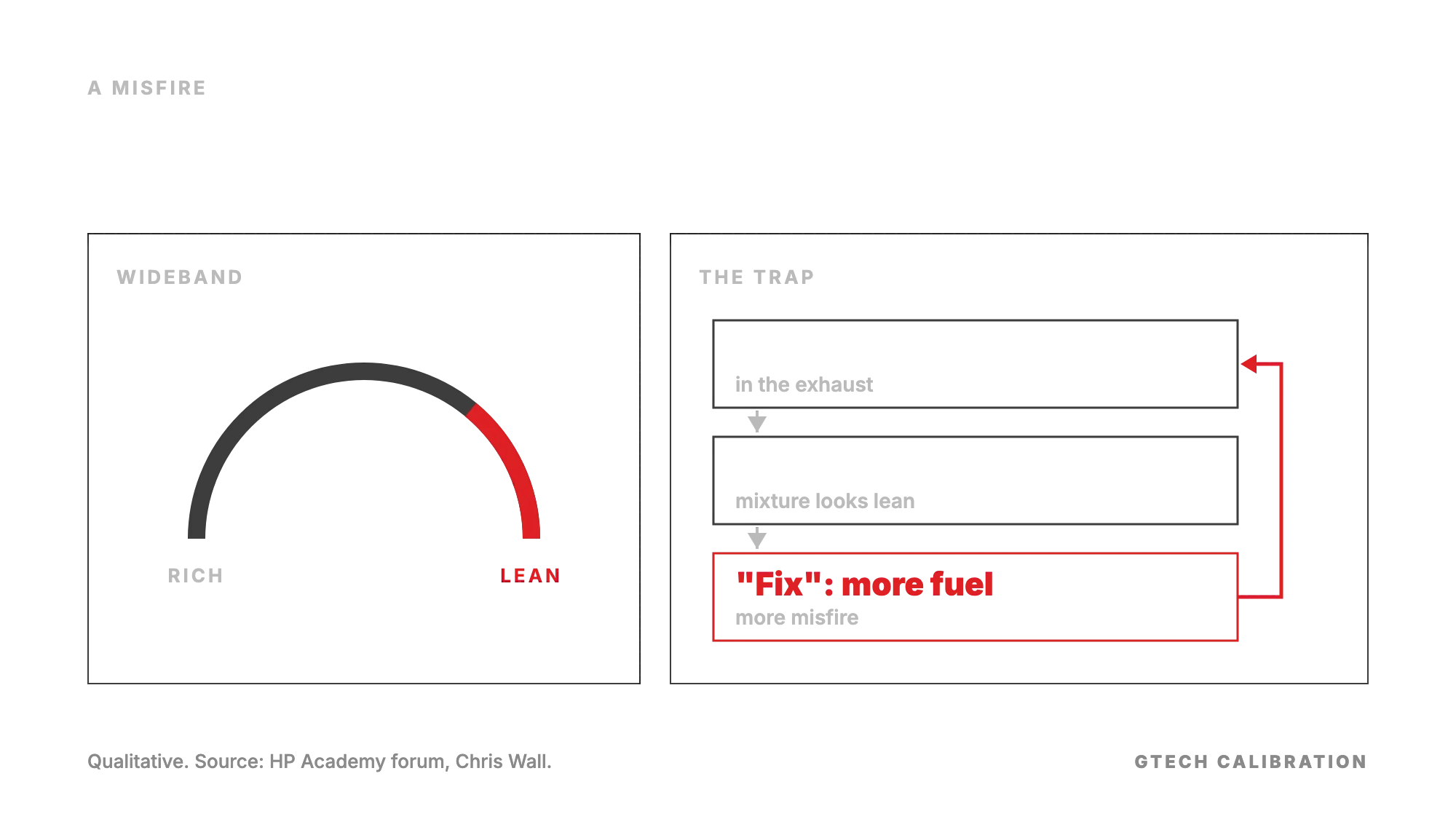
Picture what that does on the dyno or in a log:
The mixture is already too rich, and a cylinder starts to misfire.
Unburnt oxygen reaches the sensor, and the wideband reads lean.
The obvious fix is more fuel, which makes the misfire worse and the reading leaner still.
When a lean reading comes with a stumble, check for a misfire before you reach for more fuel.
Fuel is the slow fix for knock
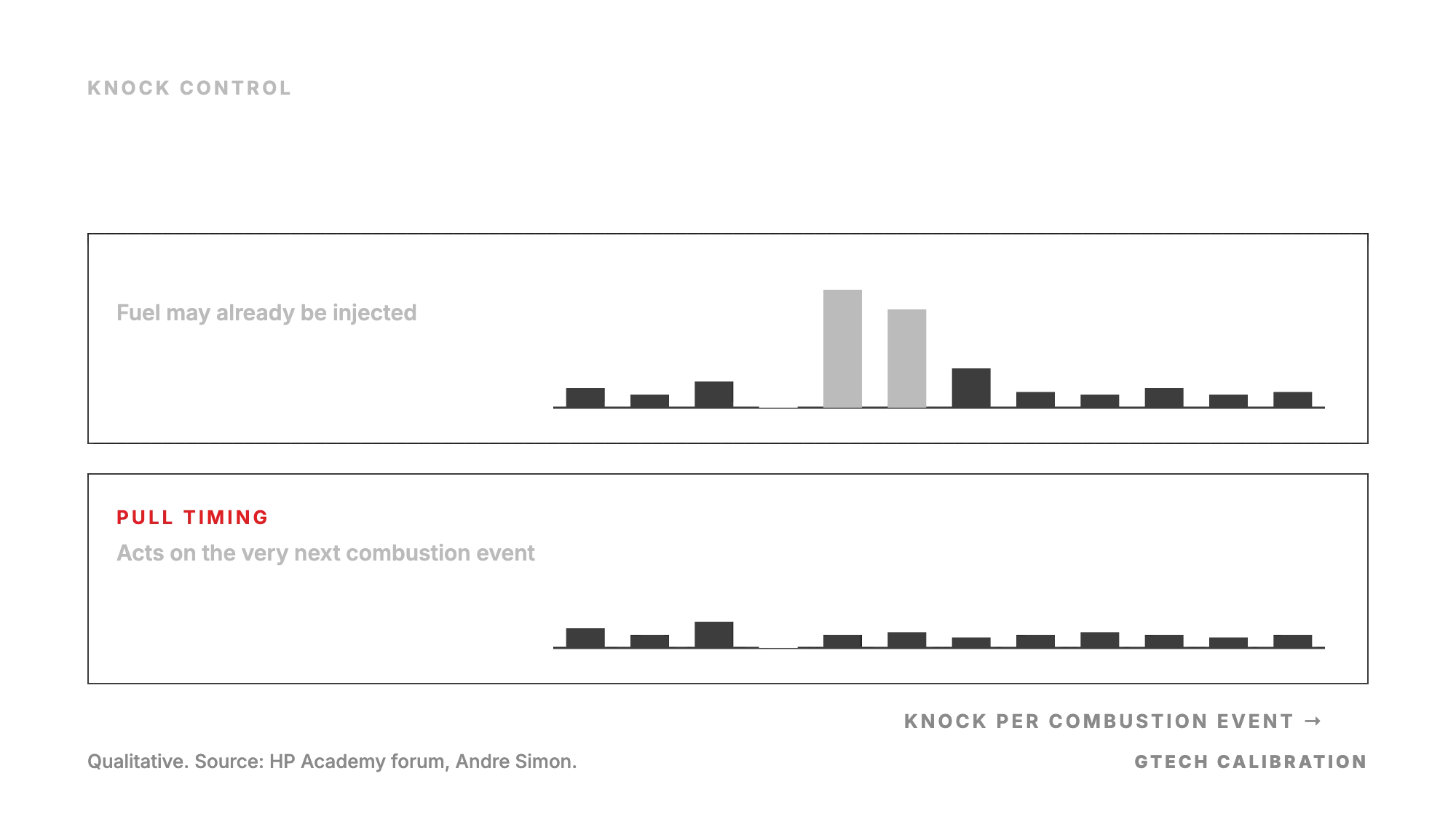
Even when knock is the worry, fuel is not the first tool. HP Academy tutor Andre Simon explains that retarding timing is the quickest and most effective way of reducing knock, which is why knock detection systems use it.
Timing can be pulled on the very next combustion event. Extra fuel can arrive too late, because depending on the injector setup, the fuel for that cycle may already have been injected. A richer mixture can still help with knock, since the extra fuel cools the combustion charge, but it is a tuning tool, not the emergency brake.
The takeaway: right, not rich
Richer is safer only up to a point, and only where it lets a knock-limited engine take a little more timing. Past that point it barely moves power, it can tip the engine into a misfire, and it can make the wideband tell you the opposite of the truth.
Safe comes from three things working together:
The right mixture. A sensible target, checked by moving 0.2–0.3 lambda either way.
The right timing. Optimised for the fuel and the engine, with knock control there to pull it when it has to.
Logs that prove it. Lambda, timing and knock read together, so a lean reading is never taken on its own.
Tuning on a wideband?
At GTECH Calibration we build calibration files with fuel, timing and knock control working together, and we read the logs before we change anything. If you are a tuner, register for the file service and send us your read.
Sources: HP Academy, Understanding AFR, "Step 4: Evaluating Changes in AFR" (hpacademy.com), and tutor replies by Chris Wall in "Borewash on full throttle" (hpacademy.com) and Andre Simon in "Dealing with knock" (hpacademy.com). Cover photo: "Spark plugs 2" by Aidan Wojtas (Wikimedia Commons, CC BY-SA 2.0), converted to black and white.